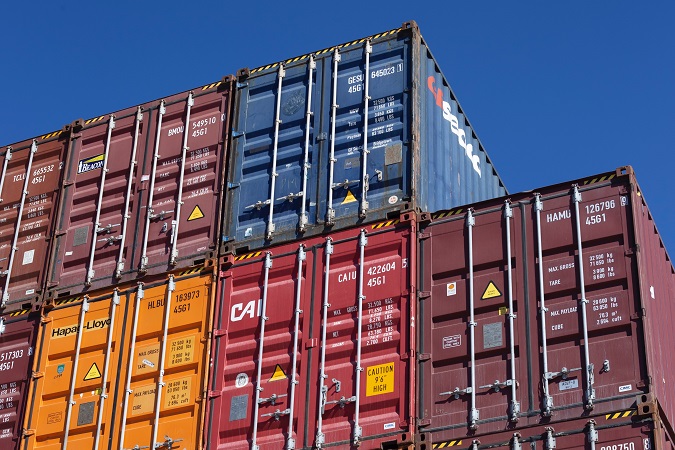

Certain ocean shipping containers will be subject to mandatory offshore biosecurity treatments as of 12 April 2012, according to new rules imposed by the Department of Agriculture, Water and the Environment. Any ocean shipping containers that are subject to the new rules, but which have not been treated offshore, will be exported upon arrival in Australia.
The Department specifically states that “onshore treatment will not be currently offered as a standard practice as movement of untreated containers currently poses an unacceptable risk”.
Small beetle, big pest
Khapra Beetle (Trogoderma granarium) is, as an immature insect, a tiny little hairy larva. As an adult, it is a tiny reddish-brown oval beetle. It may be tiny, but it’s a big destroyer of a wide range of plant products. Unfortunately, Khapra Beetle is also an excellent and opportunistic hitchhiker that particularly likes to grab a ride in cargo. So it can pop-up around the world. It particularly likes hot climates and it’s also very tolerant of dry conditions.
It is particularly persistent as, owing to a quirk of its biology, it can lay dormant for literally years.
Target containers
The Department is targeting any Full Container Load and / or any Full Container Consolidated containers that contain high-risk plant products that have been packed into an ocean shipping container in a Khapra-target country.
There are currently about 18 plant products, which includes plant products such as rice, chickpeas, soybean, lentils and wheat among others, that are on the target list. Sea containers packed in any of forty countries throughout Asia, Africa, the Middle East and Europe are also targeted.
Rural areas implementation date
The Department has indicated that high-risk containers will also include those containers that are to be shipped to a “rural grain growing area” of Australia. However, as at the time of writing (12 March 2021), there appear to be contradictory statements as to the implementation date. As at the time of writing, this industry advice notice (17-2021) indicates that the implementation date for the “rural grain growing area of Australia” will be 12 April 2021.

However, this industry advice notice (34-2021), indicates that the criteria will be implemented in “mid-2021” and that the Department will “advise of the implementation date as soon as possible”.

Shipping Australia suggests that some clarity on this point would be desirable.
Treatments
There are three main potential treatments – fumigation, heat, or an insecticide spray.
Fumigation should be carried out with methyl bromide at 80 g/m3 (or above) at 21 degrees Celsius for a minimum of 48 hours. Methyl Bromide is a colourless, odourless, non-flammable gas which is toxic to a wide range of lifeforms. Unfortunately, Methyl Bromide is also a potent destroyer of ozone in the upper atmosphere and is subject to international controls.
Heat treatment is another option. The container has to be heated to at least 60 degrees Celsius for at least three hours. However, there are numerous complexities to be managed. Variations in the heat-absorbing nature of materials in an ocean shipping container can result in variation of heat within the container, as can the way in which the container is packed. A container that is crammed with cargo will not allow the circulation of hot air evenly through the container. So a significant heating of the whole container for an extended duration is necessary to ensure eradication of pests.
Application of insecticides is the final option, but it is being offed as a “provisional treatment option” that has to be applied to the inside and underside of the container. Details of the application and treatment rate, and other elements of the methodology, do not yet appear to have been published. The burden of applying the insecticide will likely fall on the shipper or his/her agent. Prior to packing, the shipping container must be cleaned, the insecticide applied by an approved provider.
The Department of Agriculture, Water and the Environment is “strongly encouraging” industry to use the fumigant or heat treatment options instead.
The Department will require offshore-certification that the container has been appropriately Khapra-treated. The certification must meet the Department’s minimum requirements.
Beware of huge costs and delay
Shipping Australia CEO, Melwyn Noronha, commented: “We must highlight the importance of overseas exporters having adequate notice of, and an understanding of the detail of, these requirements. Importers too must be aware of these requirements. Otherwise, an untreated box may be loaded onto a ship. Our experience with the Brown Marmorated Stink Bug shows that the ship tends to get caught up in the resulting biosecurity control process. And that means delay. And delay means huge wasted costs. The one-day cost of running a 4,500 TEU vessel can currently be estimated at up to AUD$124,000 a day (depending upon variables). If ships get delayed at berth because of biosecurity concerns then numerous other costs are incurred too. The overall costs and delay can be huge”.
“Shipping Australia suggests that, just like mandatory Verified Gross Mass declarations are a pre-requisite of loading, a similar approach may need to be developed in which exporters will have to provide documentation to the shipping line as a pre-requisite to loading. This will ensure that a container does not get loaded if it has not been appropriately Khapra-treated”, Noronha said.